Search This Blog

Showing posts with label ufology. Show all posts

Sunday, April 27, 2025

Flim Flam, Fables, and the Phenomenon


The study and pursuit of something so nebulous as UFO phenomena, especially when you are open enough to include tangential phenomena as part of what is often now referred to simply as "The Phenomenon", can feel like a maddening and foolish endeavor. One can investigate UFOs in any number of ways, or some combination of various ways. UFOs have been looked as a sociological phenomenon, and from a psychological perspective. They have been studied in varying types of scientific methodologies, from the astronomical to the statistical. They can be fodder for B-movies and tabloid headlines, or they can be viewed through mystical and occult perspectives. All of these combine in a view of UFOs as modern folklore and myth-making, where the stories themselves are the important part and proof of their veracity or physical reality is secondary. After all, physical evidence is in short supply; it could be that the paradigms we have for determining "reality" of something so strange as UFOs is ill-equipped to contend with how malleable reality really is, that the physical realm isn't the only one, and that the truth tends to be found in unexpected places beyond the grasp of measurable data. 

Even when we consider the folkloric, mythic narratives of high strangeness, we are forced to contend with the old chestnut of reliability of the witness. I have tackled this subject before here on this blog, but for our purposes now I want to explore how witness testimony tends to be handled. A lot of the classic UFO stories were heralded by researchers because of the supposed reliability of the witness to the event; for instance, the Lonnie Zamora encounter- as a policeman he was thought to be trustworthy and a "trained observer". Many other incidents reported by law enforcement are held up as more reliable, and the same treatment gets applied to those serving in the armed forces or to those in academia. We gravitate towards authority when facing the unknown, even if the unknown by definition has no attendant authority figure. It seems that some amount of UFO enthusiasts have turned away from this mindset, and are more likely to consider cases like that of Joe Simonton and his flying saucer flapjacks. Of course, old Joe did have some physical evidence in the form of the pancake, which was tested and found to be composed of mundane, earthly elements- which would seem to discredit his story. It would seem that way, perhaps, but the story still persists, even though Simonton was not a "trained observer". 

Using too many specific examples may bog down the point being made here, but as a general rule most well-known UFO encounter stories, and personalities attached to them, become controversial in one way or another. Retellings of events, attempts at debunking (up to and including character assassination), profiteering, and sensationalism all play a part in weakening the credibility of a story. Sometimes the tales buckle under the weight of a little bit of scrutiny, only to be bolstered by further scrutiny of the sources scrutinizing them. Ultimately, they may fall down completely, or stand tall as a tale of mystery. If my way of writing about this seems absurdly repetitive, that's intentional- the idiosyncratic use of language here illustrates well the distortions caused by the feedback loop in looking closely at the highly strange. The caution here would be not to throw out the proverbial babies with the tubs of proverbial bath water. When scrutiny reveals inconsistencies, it may simply mean that the story is too weird to be related any other way.

UFOlogists have classically hated a hoaxer. Anyone caught in a lie (as a witness, at least) is subject to being written off entirely by some amount of what can loosely be called "the field" of UFOlogy. The major investigation groups abhorred "repeaters" back in the day; it was thought that the odds were against even a singular sighting, and that anyone with multiple such stories was likely to be a liar or mentally ill. If such a person also dabbled in magic, or lived in a haunted house, or once saw Bigfoot, the credibility meter would drop much further. Sometimes you would have what sounded like a "normal" UFO sighting, and the attendant other phenomena would be omitted from the report for fear that it would undermine the legitimacy of the primary story. In the service of presenting a palatable truth, only a half-truth was presented- and lies of omission are still lies, which then undermines the investigator... resulting in more proverbial babies being lost in the flood of discarded bath water.

We all know that lying is wrong, even though all of us do it all of the time in small ways. Even back in the days of Aesop tales were told about the dangers of lies, and the boy who cried "wolf" served as a cautionary tale. On the other hand, as noted by Aristotle, the liar can tell the truth without having to worry about being taken at his word. Maybe the UFOs, whatever they may actually be, understand this aspect of narrative and choose to visit liars simply because no one will believe them. We can extrapolate from this that they might be more likely to appear in front of someone who is under the influence of drugs, or to a comedian who no-one would take seriously. To mix fables here, perhaps the wolf is really a UFO in wolf's clothing, and no matter how much the shepherd boy cries it won't prove a thing about the reality of wolves or UFOs.

In the interest of reinforcing this unconventional idea, by way of truth-finding via unlikely source material in our own peculiar idiosyncratic fashion, let us look at the Phenomenon as Flim Flam and Fable through two obscure sources from the 1960s. 


A 1960 Mexican movie, La Nave de los Monstruos (Ship of Monsters) becomes an unlikely candidate for illustrating the nature of the Phenomenon. It stars a popular actor, comedian, and singer / songwriter of Mexico during that era named Eulalio González, often called "Piporro". He is a singing cowboy who tells all manner of fish tales to his friends, all of whom rightly dismiss his stories. It's only natural that when a pair of buxom space ladies from Venus land the titular ship of monsters in search of a male earth specimen, they find Piporro's character Lauriano.

It would be easy to dismiss the movie as B-movie balderdash, even if, like your humble writer you are a fan of the genre. La nave de monstruos has in spades everything one could want from a B-movie; monsters, a cheesy robot, pin-up beauties, and even a vampire and some musical numbers. It also does not take itself too seriously, and its the very playfulness of the movie that makes it so profoundly appropriate in relation to the Phenomenon. When no one believes Lauriano about his experiences at the end of the movie, he is able to laugh about it and go on living his best singing cowboy life. And although the assemblage of elements in the story are absurd, they all have corollaries in the annals of UFO testimony. The creature on the poster, for instance, bears a passing resemblance to the humanoids reported in the Pascagoula abduction event, which occurred over a decade after the movie's release. The Venusian woman aren't very different from the alleged flying saucer occupants contactees like Truman Bethurum or Orfeo Angelucci wrote about. The movie also has a scene in which a cow is reduced to a skeleton in an instant, at a time well before cattle mutilation became associated with UFOs. 


The purpose for the Venusian mission is to find specimens to help repopulate Venus, hence the monsters which range from a cyclopean named Uk to a Martian prince, vaguely in the form of a grey alien, named Tagual. This fits in with the famous Antonio Villas-Boas case, in which he is forced to copulate with an alien, and also later narratives about genetic and reproductive motives behind abductions that became popular in the 1980s. It's worth mentioning as well that Villas-Boas was often characterized as a farmer, less reliable and respectable than one might prefer in a witness, but this is not true. He went on to lead a normal life, and became a successful lawyer. 

Ultimately, the movie is a fun romp and well worthy of a viewing. It may interest those who are interested in UFO lore, as it were, to look at it as an allegory for the Phenomenon more broadly.

Similarly, we see this kind of narrative play out in an episode of Twilight Zone called "Hocus Pocus and Frisby". It's certainly one of the sillier episodes of the Zone, and doesn't often rate on most lists of episodes that defined the series. However, the silliness of it mirrors the absurdity of UFO stories, replete with an unreliable narrator and an incredulous audience for his recounting of events. Rod Serling introduces Frisby in his inimitable way thusly:

He has all the drive of a broken camshaft and the aggressive vinegar of a corpse. As you've no doubt gathered, his big stock in trade is the tall tale. Now, what he doesn't know is that the visitors out front are a very special breed, destined to change his life beyond anything even his fertile imagination could manufacture.


Frisby is a shopkeeper, regaling his customers with whoppers so big Abe Simpson would blush at the telling. He is played by Andy Devine, known for his work in westerns and his whistling, wavering voice. The townsfolk balk at Frisby's grandiose lies of valor and genius, but he is unperturbed and keeps telling them. No one believes him, but, as we come to learn, they love hearing his stories even if they are visibly unconvinced.

As he is closing up for the day, a pair of well dressed men in a black car pull up outside looking for fuel. Frisby can't resist his impulses, and tells them all about his inventions in automotive history and his ingenious innovations in science. The two men are impressed, and say they will see him again very soon. The Men in Black phenomenon has a very obvious resonance here. The men act strangely, seem unfamiliar with very mundane things, and cryptically tell Frisby they will see him again soon. 


It turns out that these MiB are aliens, who have landed their craft somewhere nearby. They act unfamiliar with mundane things because they are visitors from another planet, and such mundane things are exotic to them. Also alien to their perspective is the concept of dishonesty. They take Frisby at his word, and decide he is an exemplary specimen to collect and bring back to their home planet. They selected him purely because of his lies, and when he tells the truth- that he is full of hot air and just enjoys spinning a yarn, it has no effect against their decision. He manages to escape by playing his harmonica badly. For some reason the sound of the musical instrument is incredibly painful to the aliens and messes up their technology. Naturally, the teller of insane tales finds himself in an insane situation, escaping because of an unbelievable weakness these extraterrestrial visitors have.

He arrives back at his shop to find his friends have set up a surprise 63rd birthday party for him, and they present him with a trophy for The World's Greatest Liar. Of course they don't believe their old pal, and never will- but they love the stories and celebrate him specifically for his tremendous yarns. Tell us another one, Frisby, we all want to hear it... Going from one group who wants him because they believe his lies to be true, back to the safety of those who feel a sense of truth to the certainty of his lies, we have an approximation of the way the lore in UFO history goes. 

Perhaps we also have an idea about the inherent mechanisms in the behaviors and motivations of these crafts and their reported occupants. At the very least, I am led to believe we have a rough guide on the best way to proceed- with a laugh, a song and dance, or a tall tale with good cheer and friendship. After all, that's really what it's all about.





Sunday, May 21, 2023

UFO Rope Tricks and Threads From Nowhere


We all love a good yarn, and anyone who has looked into mysterious phenomena with any degree of honest inquiry is well familiar with those tales that fall apart once you begin pulling at the threads. There are a great many ways one can react to this; one may choose to discard the story altogether for fear it might contaminate the legitimacy of the other good stories, or one may hold on to it and put it in the “Maybe” pile. Still others might examine the yarn for its implications, and study those who believe it and why they do. This writer prefers to consider these loose threads, these in-between zones on the rich and mottled tapestry that is the subjective scope of Forteana, as the key to understanding how all of this weirdness - the outrageous claims, the patently unsatisfactory explanations, the investigators involved and even you, the reader - are connected.


To illustrate this point, the reader is invited to step right up and consider the Indian Rope Trick. It goes something like this: the street performer throws a rope into the air, which becomes rigid as though hanging from an unseen platform. The rope is then able to be climbed, and various avenues of performance have been described following this initial feat of the impossible.* It's classic stage magic performance, more often written of or spoken of than actually seen, it has been explained away in the past as a form of mass hallucination. The fakir, adept in clouding the minds of men, simply convinces the audience that he is performing the familiar trick, and the audience fills in the blanks as they watch the show with slackened jaws. This sounds absurd, and an early reference to such a claim came from a cousin of Theodore Roosevelt.  In a Baltimore Sun article from 1927, Andre Roosevelt claimed to have filmed the trick being performed. He and the audience alike saw the performance as advertised, but yet the camera showed no such thing! “Hypnotism!” concludes the reporter, “That is the rope trick of India.” 


The explanations of mass hallucination and hypnotism have long been a part of the UFO narrative of skeptical explanations. Often, those who make these claims are stage magicians themselves. In 1952 John Mulholland, a popular stage magician who also worked with the CIA, described flying saucers as a “state of mind”. He goes on to say that his decades of stage performance experience taught him that all manner of intelligent people “can, by suggestion, quite readily be made to see things which aren’t.” In the same decade, FATE Magazine ran an article about the rope trick; another well-known magician, Joseph Dunninger, said he knew of 37 ways that the trick could be accomplished- most of which, he said, were impossible. Included among the unlikely methods of pulling of the feat was hypnotizing the audience into believing they had seen it. The control conditions would need to be very specific for such a thing to work, and it was much less risky to use one of the others. It seems an old explanation for the magic trick, when applied to odd things in the sky, is adequate- and yet unlikely for the trick itself. But the show must go on, and so it does. One wonders if the phenomena behind the saucer sightings might not be putting on a show of its own…


Mass hallucination seems like a convenient, albeit unlikely explanation in cases where no physical evidence is left behind. Without anything tangible, with only the testimony of witnesses, we are left to grapple with the very fallible aspects of human perception and memory. Even still, without a carefully directed hand to distract them from what the other is doing, the idea that a group of people would collectively hallucinate the same thing seems as unlikely as anomalous craft from other worlds landing near a school. It may actually make more sense that, as Mac Tonnes suggested, these beings intentionally reveal themselves as a performance of some kind. If all we have at the end is a good yarn with an unsatisfactory prosaic explanation, then we have to accept that and find new ways to contextualize it. But what of those cases in which the physical evidence is all you have, and the story of the origin along with its explanation is the part that’s missing? Enter: the Mystery Threads from Nowhere.


In August of 1970, according to Berthold Shwartz and later reported by John Keel, a silver thread inexplicably appeared over Caldwell, New Jersey. The thread, it appeared to Dr. Shwartz, “came from no place and went no place. It just hung there.” This phenomena was referred to as “Sky-Lines” in a 1971 issue of Pursuit Magazine, wherein the writers who investigated the case found at least half a dozen of such strands of what appeared to be fishing line dangled from an imperceivable source. In one instance, over the course of the several months these mysterious nylon strands grazed the ground in Caldwell, four local boys spent an hour hauling in the line before it finally snapped. Analysis of the strands by DuPont revealed that it was a nylon material of some sort, commonly used for fishing line, but the source remained a mystery. Perhaps even stranger, when Dr. Shwartz sent a sample of the material to another investigator, the envelope arrived intact with nothing inside of it. The strand had disappeared, presto change-o, as mysteriously as it had arrived. The mystery threads here seem to defy categorization; other than the fact that they seemed to come from the sky, there is no direct link to UFOs. In opposition to tales of sightings which leave no physical evidence, as concluded in the Pursuit article, “we have the thing, but the how and why of it remain totally mystifying.”


Mystifying though it may be, this was not the first case of Mystery Threads from Nowhere. In 1955 a small town called Blakedale, in South Carolina, was tangled up in its own anomalous twine. The string was described as being like the kind used to fly a kite, but not strong enough to hold a kite. A tangled ball of it was discovered on the roof of a Mrs. Smith, and the children took turns pulling on the drifting string until they tired of it and broke it off. The thread seemed to continue across town, leading to speculation that it had something to do with the military or perhaps came from a weather balloon, although neither explanation was borne out with any evidence. The only origin everyone could agree on was that it came out of the sky…


Another account was from a man named Hut Wallace, who discovered a glimmering strand above his house. Reported in a 1973 issue of FATE Magazine, the Georgia man called his friend who worked for the Atlanta-Journal Constitution to come and see it. Neither man could see any source for the dangling string, it just seemed to come down from a clear blue sky. Wallace’s nephew eventually got on the roof and hauled in yards of what appeared to be green fishing line, but never saw anything at the other end of it. A nearby company manufactured similar products, but how it could have gotten into the air, and what could possibly have dangled it, again beggars the imagination. 


The final example I will include here is the first one I came across, and had filed it in my memory as simply a good yarn as it was an anecdotal accounting of events and sounded utterly bonkers to me at the time. After all, who had ever heard of Mystery Threads dangling from the sky? The story was shared on Facebook by a man named Tim, and it occurred at Stonehenge in 1976. He was there for a music festival, when a kid handed him a string coming out of the blue sky. He figured there was a kite, but he couldn’t see anything at the end, so he started to reel it in. He could feel the pull as though there were a kite, but after 45 minutes of pulling in line he decided to pass the string off to some “likely looking candidate”. He admonished the man to not let go- “after all,” he said, with a wry wit that one often finds among the British, “we don't know what's on the other end... it might come crashing down, it might be depending on us, we might be depending on it... what if actually 'it' is flying us?” He concludes by wondering whatever happened with the string, and whether somewhere, someone is still holding the end of it. “I certainly hope so”, he said. 


There is something uncanny, mind-bending, and existentially disquieting about something so mundane as a nylon line defying all that we know of physics and by extension, reality itself. For such a common, unremarkable thing as a string to buck the norms of our expectations and leave itself behind for examination, only ever leaving in its wake more questions, one gets the sense that the yarns we take in, and the threads that we pull on, inform aspects of our shared experience of the world and all its weirdness far more than we care to let on. What if some being was “flying us”, holding on to the other end? What if, as suggested jokingly in an article about the New Jersey thread, something was fishing for us? What if the Mystery Threads are just intergalactic performance art, a way for the phenomena to show us an Indian rope trick of its own? After all, the rope trick is just that- a trick. Isn’t it?


I encourage anyone reading this to chase down these yarns, to pull on these threads, and remember to have fun with it. It’s all a show, and there’s no sense in coming apart at the seams…


-------------------------------

Addendum: a bonus "yarn" that's almost definitely not true, from The Saturday Blade, January 5th, 1895, in Chicago, Illinois.


*
An oversight on my part- initially I failed to actually describe the Indian Rope Trick. This has been corrected. The writer would like to express gratitude to his friend Theresa Meis, the Unicorn who breaths Fire, for pointing this out!

Saturday, February 11, 2023

Full of Hot Air- Ruminations on UFOs and those Numinous Balloons

 At the time I sat down to write this, news and social media had been all abuzz about a Chinese spy balloon seen floating across the country. It was, eventually, shot down. I was surprised to see just how many people on social media had become national security experts overnight, as it seemed everyone had ideas about what should be done. I'll admit that I don't know anything about spy balloons, or why on earth such low-tech espionage would be necessary in today's technological age- but the particular interest among the Disclosure set, and those on hashtag UFO Twitter, got me thinking about the symbolic nature of balloons and, more specifically, this symbolism in relation to the topic of UFOs. 

I was unable to finish writing this post the first time, and now, a week later, as I sit to complete it more objects have been shot down from both the U.S. and Canada...


My good friend, the right honorable Most Reverend StarDoG pointed out on Facebook:

You have to chortle at so many of those who are forever telling people that "People are losing their shit over a weather balloon and there's nothing strange here, please move on", currently, totally losing their shit over an actual weather balloon..

-Steve Mills, author of the blog post You're Just Like a Little Child Chasing a Balloon into the Sunset

The irony related to balloons runs deep in UFOlogy. "Weather balloon" is one of the classic hand-waving dismissals of UFO reports since the 1940s, alongside the planet Venus, misidentification of birds or known crafts, and Swamp Gas. Weather balloons and UFOs are inextricably linked, and as I intend to persuade you through my ramblings here, the symbol of all balloons hints at something existentially unsettling and as hard to capture through words as clouds are in one's hand. 

Back in 2020, a "leaked government photo" of a UFO, taken from inside a jet, was revealed to be remarkably similar in size and shape to that of a party balloon featuring DC Comics' Dark Knight, Batman. At the time, I found this profoundly amusing, and perhaps an indicator of the Cosmic Trickster at play. I had often felt that the extreme camps of those who engage with the Phenomenon, as it were, were exemplified by the Disclosure Set/TTSA mob, and fans of the documentary series Hellier. This dichotomy is often expressed as the "nuts and bolts" camp vs those open to a panoply of interpretations, bordering on the mystical and visionary. In cryptozoology, it might be the "flesh and blood" camp vs those open to supernatural answers for why we see Bigfoot and other beasties. In the interest of disclosure, although it's probably entirely obvious, I fall into the latter camp. The caveat is, I don't think either extreme at the exclusion of all evidence to contradict it is healthy. While I think chasing capital "D" Disclosure is a fool's errand, I also think there is a very real danger of missing the forest for the synchronici-trees.

A major part of Hellier, for those who haven't seen it, involves a blue star balloon that served as a synchronicity during the course of the investigation more than once. The balloon in question has become as emblematic of the Hellier goblin-hunt as the goblins themselves. In this sense, it seems amazingly on-brand for Trickster phenomena that the other extreme, who likely would not respond well to the language of high strangeness, to be taken in by a blue Batman balloon. 


In Tim Burton's 1989 movie Batman, balloons appear in the form of a dastardly plot perpetrated by the Joker. As he is throwing money out the people of Gotham, the floats above him are loaded with toxic gas that he hopes to unleash on the unsuspecting public. Of course he is foiled by the Caped Crusader, who flies in in his Batwing, towing the balloons to a safe distance from the city. This heroic act is mirrored later in the 2012 movie The Dark Knight Rises, in which Batman has to (we're led to believe) sacrifice himself in bringing a bomb out into the sea to save the city. 

The clown imagery and invitation to collect money in the scene, along with the hidden horror of the plot to poison Gotham, within a balloon, get at this odd symbolic quality of the unassuming and seemingly friendly object. A balloon might not be what it seems; is it a message from the cosmos, a whimsical decoration, a UFO, or a parade float filled with poison? Already, we can see that pinning down a straightforward meaning here is as evasive as the string of a free-floating balloon that has just left your grasp...Another relevant sinister clown / balloon connection is worth mentioning here- a single red balloon has also been a symbol of the character Pennywise in Stephen King's It.


The shape-shifting entity, most often portraying itself as a clown, is revealed to be (spoiler alert) a giant spider from either space or another dimension. The balloon sometimes acts as a harbinger of his appearances, or as a way to lure victims to their doom.

During World War II, balloons coming from Asia were a major concern for the United States, particularly along the Pacific Coast. Japan had released balloons loaded with incendiary devices, as a means of attacking the U.S. mainland. Balloons were also used during the war to distribute pamphlets of propaganda across enemy lines, or as a means of communication. All the while, phenomena such as "foo fighters" and ghost rockets were reported by airmen. After the war, the flying saucer age began with the publicity around the Kenneth Arnold sighting- but before the war, there were reports of mystery airships. Dirigibles, essentially piloted balloons, were reported throughout the country. 

These mysterious airships seemed to be just ahead of where commonly accepted technology would take us, but as zeppelins came into use they seemed less mystifying. They might have enjoyed greater use as a means of travel, had it not been for the widely publicized Hindenburg disaster in 1937. The words of the reporter covering the disaster - "Oh, the humanity!" have become ingrained and meme-ifed into public consciousness to this day. Public trust in airships dropped quickly following the crash.


The Hindenburg crash was featured as the cover art for Led Zeppelin's self-titled debut album, related to a joke spurred by the suggestion of a line-up of musicians in a band- that it would go over like "a lead balloon", or a "lead zeppelin". 

Years later, Pink Floyd would cause UFO reports of a sort with a botched album cover photo shoot. For their 1977 album Animals, the plan was to get a shot of a balloon shaped like an enormous pig floating above the Battersea Power Station. The pig balloon was custom made by a German company called Ballon Fabrik, who had previously constructed zeppelins. For the first attempt at getting a good photo, they had hired a marksman to shoot down the balloon if it became untethered. The second day, they failed to bring one, and it floated away...


The balloon eventually landed in a farmer's field, and he was reportedly furious that it had frightened his cows. Here we can see not only the UFO and balloon symbols merged together in one event, but also cows, which in popular media are often portrayed as victims of abduction. Beyond that, the likelihood of ever getting a straight answer with UFOs is so slight, it would seem that "when pigs fly" would be a reasonable expectation on when we'll have it figured out. On another, weirder level, Pink Floyd got their start playing at the UFO Club in London- which was managed by the co-founder of IT magazine Joe Boyd, who helped finance the recording of the band's first singles... right around the same time a newspaper article made the rounds in the U.S. about a police officer named Dale Spaur, who had taken to using the code name "Floyd" for a flying saucer he saw multiple times.


The imagery of a pig was part of the thematic lyrical structure of the Animals album- Roger Waters was drawing from Orwell's Animal Farm, a critique of Communism, but turning it on its head as a critique of capitalist, commercial society. He would later expand on the Orwellian themes in the later album The Wall, which was more inspired by the book 1984. 

In 1984, Nena's song 99 Luftballons was released in an English-language version to capitalize on the success of the original song in Europe. American audiences preferred the original German version over the translated 99 Red Balloons. Nena would express disapproval at the the translated version, as it seems the meaning gets lost in translation. The basic premise is that 99 balloons, tied together, are let go and float into a neighboring airspace and mistaken for UFOs. This leads to jets being scrambled, and using firepower, which builds up to a cataclysmic war that destroys the world. The anti-war song concludes with the discovery of a single balloon in the rubble, and the line "I think of you and let it go". 

The song was inspired in part by balloons let go during a concert in 1982, causing Nena's guitarist to wonder what would happen if they floated over the Berlin Wall. Also cited as inspiration for the lyrics was an apparent prank using balloons to hoax a UFO in Las Vegas, by students in 1973. It seems that there were several such hoaxes that year:

Balloons and hoaxing seem to go together well. In 2009, a flying saucer shaped balloon made the news when it was reported that there was a child trapped inside. The "Balloon Boy" hoax was characterized as a ploy for publicity and attention from the couple who launched the balloon, Richard and Mayumi Heene. To this day, they and their son who they originally claimed was in the balloon maintain that it was not a hoax, but a mistake. Another example of a balloon based saucer hoax occurred in 1989, when rich guy with too much time on his hands Richard Branson spooked motorists in the U.K.:


Sometimes, though, balloons are just a means of adventure, whimsy, and fantasy. Take for an example the sky journey of Kent Couch in 2008. The 48-year-old owner of a gas station rigged up a bunch of balloons to a lawn chair and spent 9 hours aloft, covering a distance of 235 miles from his starting point in Oregon. Using a BB gun to take out balloons and lower himself when necessary, he landed safely in Idaho. "I think most guys look up in the sky and wish they could ride on a cloud.", Couch said in an interview.


As I type this all out, it does seem eerily likely that tensions are mounting around balloons from across the Pacific. I certainly hope nothing like the 99 Luftballons scenario plays out, and I would hope that we can all move toward a more adventurous and whimsical view of balloons like that shown by Kent Couch, or as utilized in the Pixar movie Up. We do seem to be living in an increasingly crazy world, a place where alien craft making an undeniable appearance seems more likely; but on a scarier note, with a recent pandemic, climate and weather changes, and political tensions high all around, it's easy to feel like we're on the precipice of a great change. What that change is, and whether good or bad, is as hard to determine as the motives of a balloon drifting across the pacific ocean. This brings me to one final balloon image culled from pop culture- the balloon to take us home. And if you've made it this far through my ramblings, I really can't thank you enough.


At the end of The Wizard of Oz, the all-powerful Wizard has a solution for Dorothy. The plan to bring her and Toto back to Kansas involves getting into a hot-air balloon, but at the last moment, as the balloon is taking off, Toto jumps out. Dorothy has to go running after him, as her only hope for getting home appears to drift off above the Emerald City. It's then that she learns the power to bring her back was with her the whole time; and maybe that's the lesson with balloons. Maybe, perhaps, as Nena sang, we should think of each other and let it go. Maybe chasing balloons equates with madness, and certainly there's danger in it. Maybe I'm crazy for ruminating so long on the topic, and bringing up such far-flung images to illustrate the nebulousness that is UFOlogy. I'm sure it could be argued that I am, indeed, full of hot air, high on my own supply... but like many other guys, I just want to know what it's like to ride a cloud.


Friday, February 4, 2022

Forteana for a Froggy Evening

    Frogs hold a special place in the annals of Forteana - Charles Fort documented cases of frogs falling from the sky in his book that started it all, The Book of the Damned. Among the many instances of "damned facts and evidence" he collected, the frogs were only one example of things falling from the sky that seemed impossible. These odd events provided him a great platform from which to lampoon the attempts of scientists to explain them away. The rational explanation usually involved a waterspout pulling aquatic or amphibious creatures from the water and depositing them with rainfall elsewhere; the animosity between the rational approach of scholars at the time and Fort's sarcastic material agnosticism is a hallmark of all manner of Fortean subjects to this day.

    Other notable frogs within the weird fringe literature that can loosely be called Forteana are of course the Loveland Frogmen, who may not have even looked all that froggy at all. Various descriptions had been given for these odd creatures, which were reported in Ohio in the 50s, the 70s, and more recently - none of which matched the official explanation that someone's pet iguana had gotten loose, lost its tail, and was mistaken for a flying saucer occupant. Further, though not immediately evident of frogginess, there's the Hook Island Sea Monster photo. Evidence overwhelmingly suggests that this photo of an injured sea serpent is a hoax, but to this writer's eyes it looks like an enormous tadpole. Of course, such a tadpole would imply the existence of a Gargantuan Sea Frog. Imagine how large such a frog would be, how it would live, and what it would eat! We've now cast off from familiar shores out into the waters of pure imagination and conjecture, a place that might be requisite for appreciation of this blog.


          Yet another example of frogs posing unique questions to the Fortean mind is the phenomena of entombed animals. Claims dating back to the mid-19th century have documented instances of live frogs (and sometimes lizards) being freed from inside a lump of coal or a rock. This sounds absurd in the extreme; while frogs are known to hibernate encased in mud for several months, the amount of time it would take for mud to turn into rock would be far too long for any animal to survive, especially without food or water. In most reports, the frog dies shortly after being liberated from the stone. This phenomena is mostly discredited these days, but since we're still adrift in the numinous tides of speculation we won't let that concern us too much. Whether this is a 'True' phenomena or not, it provides a perfect segue for the main subject of our Froggy Night Feature: High Strangeness!


        The 1955 Warner Brothers cartoon "One Froggy Evening" may seem at first glance to have nothing to do with Forteana or High Strangeness. It's a weird premise for a cartoon, but it's a classic and a very funny one. The plot shows a construction worker at a demolition site who discovers a time capsule in the cornerstone, in which there is a living (and very lively) frog. The frog then proceeds to dawn a top hat and perform a song and dance with a cane. Michigan J. Frog can be interpreted as an "entombed animal". There is evidence to suggest this cartoon was inspired in part by the tale of Old Rip the Horny Toad, a horned lizard that allegedly survived being kept in a time capsule for 31 years in Eastland, Texas. Chuck Jones, the legendary cartoon director who managed this particular piece, gives the credit for the character and plot to his friend, writer, and gag man Michael Maltese in his autobiography Chuck Amuck. "The quirky brilliance of his ready wit was never neutral.", he said of Maltese; "He disdained facts as useless-- only the odd, the unusual, the hilariously peculiar interested him." Regardless of Michigan J. Frog's provenance within the varying fields of the weird, we can use him as a totem for how the phenomena of high strangeness acts - and how we interact with it. 

    After all, many of the strange events that those of us who have an interest in such things research really are "hilariously peculiar", which has in recent years led to fertile grounds for jokes on paranormal podcasts. A great many UFOlogists over the decades have dismissed the cases that seem too "out there", or omitted the laughably strange details from reports in an effort to present the case seriously. This applies also in ghost hunting and cryptozoology; often the desire for the case to be presented as worthy of honest investigation means it must be trimmed of anything that makes it sound too bonkers. Worse still, witnesses will fail to report the exorbitantly strange details of an event, even if they will generally share that it happened. 

    So what are we to do when we encounter the Singing Frog of High Strangeness? The events of the cartoon show us a few possibilities, each of which is echoed by examples through the history of investigations into the very weird. The Worker, who is never named, initially thinks only of the money to be made off of such a discovery - only to find that the frog will not dance on command for others. Hucksterism, grifting, and opportunist entrepreneuraliasm are rife within the history of all manner of weird subjects, as is the unrepeatability of odd effects. Places famous for their monsters see a lot of tourism purely for that reason, which is all the more reason to promote the mystery. It's not surprising that some who possess a Singing Frog would seek to profit from it, and although they sometimes do, they never really can prove that it's genuine. A good deal of experiencers and researchers have had their hopes of cashing in or even just getting recognition dashed to pieces by an uncooperative phenomenon.
    Witnesses to genuine events are met with doubt because of the fleeting nature of weird phenomena. Like a frog that only dances when no one else is around, witnesses can only describe the experience, not reproduce it. They generally have to be taken at their word without evidence to bolster it. The average person is not generous enough to do that, and although a lot of these ideas are becoming more mainstream they are likely to be shown the door- just like the Worker when he brought the frog to the Talent Agency.
    The mind-bending weirdness of some of these accounts is exemplified well by the "diabolical frustration", as Jones put it, that Michigan drives the Worker to. He rents a busted old theater, fixes it up and invites the public to come see. No one is interested until he puts a sign out that says "FREE BEER", and - alas! - he is unable to open the curtain in time for the crowd to see the frog sing. Where one man sees an extraordinary, phenomenal miracle others simply see a mundane, croaking frog... and they proceed to pelt him with fruits and vegetables. It all feels reminiscent of the revelatory claims in the ever-impending but never arriving government Disclosure of UFOs, or any bold pronouncement of conspiracy theorists. The average person has to be bribed into caring at all, and the reasonable among them will scoff when results fail to appear. Likewise, some phenomena seems awfully performative while at the same time very particular about its audience. The Worker in the cartoon is a lot like "repeaters" in UFOlogy, or those who have many varied stories of otherworldly encounters. For whatever reason, there are those seemingly genuine people who attract strangeness, or are perhaps more cognizant of it- but not in a way that can be confirmed by others. Diabolical frustration, indeed.
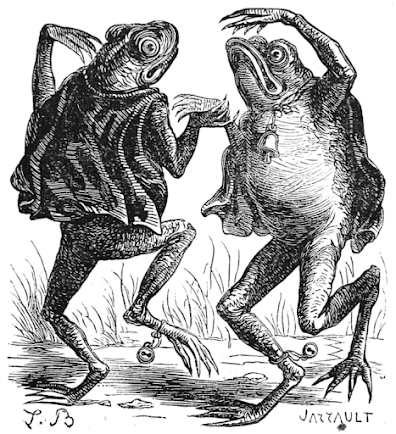
    Incidentally, there is a precedent for diabolical dancing frogs- as illustrated here from the 6th edition of J. Colin de Plancy's Dictionnaire Infernal. Frogs were often associated with witches, and thought to be demons posing as frogs. Also, frogs were thought to be potent ingredients in magical workings.

    "One Froggy Evening" in this sense becomes a cautionary tale about how best to interact with a bizarre, highly strange situation. Perhaps the funniest moment comes when the Worker, now destitute and miserable, sits on a snowy park bench while Michigan belts out "Largo al factotum" from the opera The Barber of Seville. This attracts the attention of a police officer walking the nighttime beat. The cop, investigating the loud singing, is flummoxed by the Worker blaming it on the croaking frog. He is then left with no choice but to drag the man off to the Psychopathic Hospital, where Michigan continues to serenade him.
    The funniness of this scene has a much darker correlate in the avenues of investigating, researching, or simply living with highly strange events or circumstances. It really can drive one crazy, or at least lead outsiders to assess a witness as such. People of all walks of life can become obsessed, entirely invested in proving their claims or in more tragic cases, seeking help. Many anomalies seem to exist to fulfill the function of being anomalous; many mysteries will never be solved. Trying even at the expense of one's well-being to be the one who solves these mysteries is a path that often leads to madness. A good deal of witnesses and experiencers become ostracized from their communities, lose their jobs, and have their lives turned upside-down by the act of telling the truth as they know it. Some of them are likely lying, or mistaken, or cognitively disadvantaged. The fact remains, however, that strange encounters really do change people - for better or worse.

    The cartoon ends with the Worker seeing the opportunity to ditch the box with Michigan J. Frog in it at a construction site, and it goes right back into a cornerstone. 101 years later, the Future Worker once again liberates the Singing Frog and the cycle starts again.

    The diabolical frustration and madness of what can broadly be called The Phenomena is contagious, and the old stories appear over and over again with every new generation of Forteans, UFOlogists, ghost hunters, legend trippers, and weirdos. Our reactions to it may change, and that is for the best. How different would it have been for the Worker to just take the frog home and enjoy the song for himself? It would have been a boring cartoon, but the Worker would have been better for it. There's no right or wrong way, necessarily, to engage with weird stuff when it happens to you. There is perhaps a way to interpret your experience in a way that is deeply personal- and that means it doesn't need to be widely shared, or proven. Some phenomena is meant for you and you alone; you may watch the frog sing, but don't let it break your mind! 


Friday, July 9, 2021

"You're Just Like a Little Child Chasing a Balloon into the Sunset" - Guest Post by Steve Mills

The following is a guest post by my good friend Steve Mills, aka the Most Reverend StarDog. He has some thoughts and research to share regarding the infamous Mantell Incident. Please enjoy this guest appearance, and I hope to be writing more soon!

Steve can be found at @StarDoG23 on Twitter

-AP


    The above title is my all time favourite putdown from TV or film. It comes from the mouth and wandering psyche of the inimitable Vince Noir, one of the two main characters along with Howard Moon, from the UK comedy series "The Mighty Boosh". In this case it is perfectly apt for what I am about to reveal to many people.

    The story starts about a decade ago whilst I was watching one of the plethora of UFO documentaries on the various cable/satellite channels. Two ex RAF crew with thousands of hours flight experience are talking about their sighting from the early 1950s. During the interview one turns to the other and says something like "Well, it was known in the pilot's mess that, chasing these things (UFOs) could get you killed". That casual, almost throwaway comment, stuck with me. Two vastly experienced and typical, to point of almost an Ealing comedy or Pythonesque cliche, RAF crew openly admitted that, in the early 1950s, UFOs were a subject of conversation in the mess and that, they were talked about as "dangerous". In simple terms, I wanted to try and understand why?


    It has to be pointed out that many aircrew at that time were battle tested and hardened veterans of WW2 and they were often superstitious and then some. Consider a RAF bomber crew's odds of survival on any given mission over Germany was about 50-50 it's not hard to understand why any crumb of comfort was grasped and held onto for, literally at times, dear life. Be it a teddy bear or a garter from the dancer at that show, there wasn't much, in terms of personal ephemera, that didn't find its way over to Germany on some bombing mission. Given that, it's not hard to understand why stories of "Gremlins" and "UFOs" were taken, just maybe, a little more seriously by aircrew than by most folk. Maybe that explained the mess talk and that's all it was; just a way for people carrying out a pressurised role to just blow off steam?


    However, given many legends are based on some actual occurrence my mind then wandered to where these stories may have originated from. As such, there are really two cases in the public sphere that immediately spring to mind. The Kinross incident and the loss of Captain Mantell. I discounted the Kinross incident as it occurred in 1953 and the incident the two RAF aircrew were involved with a was 1952 so, that leaves Captain Mantell. I would guess that, were one to compile a list of "Top Ten UFO Cases", then the loss of Captain Mantell and his F-51 propeller-driven fighter on January 7th 1948 would figure in many people's lists. I knew the case pretty well from numerous books and online articles, truth is, as will become apparent, like 99% of people with an interest in the case I thought I knew it and the chief too-ing and fro-ing between the various camps seems to involve the "Skyhook balloon" explanation. As it turns out, the whole "Skyhook explanation" is what Stephen Fry would refer to as "Utter arsegravy" - again however, I am jumping ahead of myself.


    One thing I have learned over the decades is this. Both pro and against camps in the UFO field "make shit up" (See Note at the bottom of the article) and leave important details out that might not fit a person's particular agenda. That's human nature and confirmation bias is what drives many people on both sides of the argument. The Mantell case is a classic example of this and I eventually discovered that we are all wrong about what we think happened and way more crucially, about when it happened. 

    If there's one thing i try to do in any case it's return to the actual words of the witnesses and not rely on their words filtered by any particular agenda. In Mantell's case I thought I had found the definitive version of events, in of all places, a 1956 documentary made with the co-operation of the US military. (There's a link to said documentary at the foot of this article alongside the notes). From that documentary i collated the following timeline of the events that January day in 1948 and they are as follows.


......................January 7th 1948 14:00 approx Kentucky State police report to Fort Knox military that they have sighted an unusual aircraft or object, flying through the air, circular in appearance approximately 2-300 feet in diameter and moving Westward. Provo Marshall at Fort Knox called Godman Airbase.


13:50 object spotted south of the airfield from the Godman control tower some 35 minutes after the "object" was first reported.


A B29 and an A26 were both on photo missions in the area.


Object seen by the tower controller, Lieutenant Cowan and Operations Officer through binoculars. Operations Officer puts in second call to the commanding officer Colonel Hicks. Hicks arrives during the phone call at approximately 14:20.


Aprrox, 14:30 A flight of four F51s arrives over the field.


Hicks orders the F51s to be contacted to ascertain who the leader of the flight was. Captain Mantell,

Mantell ordered to change course to 210 degrees and investigate the "unknown object".


Lieutenant Hendricks requests to land and refuel and take on oxygen, permission granted.

Both wingmen refueled and took off again this time carrying oxygen


14:45 Mantell calls the Tower "I see it, above and ahead of me, I'm still climbing"...


Moments later one of the wingmen calls in.. "What the hell are we looking for?"


Seconds later Mantell.."Mantell to tower, the object is directly ahead of me and above me, now moving at half my speed"

"Mantell to tower it appears to be a metallic object of tremendous size"


The object was also in view of all the tower personnel.


"Mantell to tower, I'm trying to close in for a better look, I'll go to 20,000 feet"


Shortly after Hammond, one of Mantell's wingmen calls Mantell "Level off captain, till I regain visual contact"

Mantell is silent, no reply

Moments later Hammond makes another transmission. Mantell seems to have disappeared and climbed beyond his wingman's view

15:25; the remaining wingman breaks off and returns to base


The object visible throughout the chase from the Tower, disappears from view at approximately 15:50. F51s first lost to view object disappears behind a cloud.


At 17:50 they are advised that Mantell had crashed 5 miles south west of Franklin, Kentucky. The crash had occurred at approximately 16:45; Mantell is killed in the crash.


Notes: Franklin is roughly 90 miles from Godman airbase. If Mantell vanished at approximately 15:20 and crashed at 16:45 then he was flying dangerously close to the stalling speed of a P51, (100MPH).  Where was he for that hour? It should have taken his plane no more than 20 minutes to fly from the area of the airbase and Franklin. 


                                     ......................................................................


Tower controller's statement: "It looked silver or metallic"

Intelligence officer's statement: "It appeared to be a bright silver object"

Executive Officer's statement: "It was circular in shape"

AACS statement: " A small white object in the sky"

Operation's Officer's statement: "It appeared round and white"

The Commanding Officer's statement: "It could be seen plainly with the naked eye"

Some present had no memory of Mantell informing the tower that he was "Moving in for a better look'...

    Strap in, because this it where is becomes "sciency". My interest in UFOs and my school years left me with a side interest in military aircraft. I'm no expert and certainly no "rivet counter" however, I do have a decent grounding in what an aircraft of a given type can and cannot do. If an aircraft is involved in a major incident I will  trundle along to the rivet counter websites and glean as much information about said plane in an effort to better understand what might have happened. It was this nerd like attention to detail that first led me to suspect something was drastically wrong with the accepted version, by all parties, of that day's events. According to the "officially accepted" explanation Captain Mantell "vanished" at some time between 14:45 and 14:50 hours that afternoon and crashed at 15:45 local time near Franklin, Kentucky. However, there's an immediate discrepancy here as by contrast, virtually all reports state that Captain Mantell's watch had stopped at 15:18 and that was the moment his plane hit the ground.


    However, this was not what concerned me. Even if he did crash at 15:18 then it still begged the question where Mantell's plane was for between 30 minutes and an hour after it's assumed he had passed out and lost consciousness from anoxia. Why, you might very well ask? The answer is a rather simple one and one I suspect most pilots of that era would have intrinsically understood. The F-51 is indeed rather easy to fly for an experienced prop pilot, being both light of touch on the controls and fairly stable even when you throw it through some aerobatic manouevers. However, there is a caveat- a rather large one at that- the moment you take your hands off the controls the Mustang behaves like the equine it's named after. Within 3-4 seconds the plane will  begin to drift in whatever direction the torque of the propeller is pulling it towards and in short, within 5 seconds, that F-51 becomes an 8000lbs+ anvil. That is, ten seconds after Mantell's hands left the controls, or lost the ability to guide those controls, it began to fall out of the sky. I did a rough calculation and erring on the conservative side and with two wings intact, a F-51 has a terminal velocity of about 1380 feet per second. In MPH that's 940 MPH and well past the speed of sound. This possibly explains the "explosion" that the witnesses on the ground saw as Mantell's plane descended in its crash dive. What probably happened is that, as the plane's velocity grew closer to the sound barrier it began to literally shake apart, you can look this effect up- it's well reported by pilots in dives during WW2- and indeed, it lost a wing and other parts of the airframe literally were shaken off. The "explosion" might have been the plane actually making it through the sound barrier and the wing being torn off. They key point to all this however is this, from the moment Mantell passed out to the moment his plane hit the ground was a couple of minutes. If he crashed at 15:18 then, according to the accepted timeline, he had been missing for nearly 25 minutes and that makes no sense. 


    Not to put too fine a point on it, I was stuck. Either Mantell was flying that plane under the effects of anoxia for between 20 minutes to an hour (Remember the "official record" cough cough, supposedly claimed he crashed at 15:45 local time) or, the plane was flying itself. In the final analysis, neither of these options makes any sense and looking for a rational explanation I expanded my search. I looked for what was "missing" from the evidence and the fact that, I could find no record of his 2 fellow pilots version of the events; as the only people who were with him that fateful day this struck me as strange. This is one of the most famous UFO incidents and yet, seemingly, not a word from the key witnesses. It was becoming somewhat frustrating and then, through a piece of lateral thinking I found this obscure and seemingly forgotten blog piece on the incident. 


    If we accept the facts espoused in the piece and that the author was writing with honest intent then finally we have the true story of Captain Mantell and the proper timeline. It does of course beg the question as to quite why the military have obfuscated for decades about the incident and I suspect that comes down to a simple fact- That being, if you write an article "Pilot dies whilst chasing a UFO" you are 100% correct and the military simply had no desire to deal with the questions that come with that sensational headline. It also shows that "The Skyhook believers" are really no different to the most out there "UFO believers" and that, their intransigence is every bit as unscientific and irrational as that they claim to rail against. As the blogger so rightly points out, the reality is, as a UFO incident, it's really not that fascinating and it was the crash that gave it its probably undeserved extra kudos. In conclusion then, I admit to a certain smugness that my hunch about the actual mechanics of the crash must have followed the path I thought they would  because I'm human, it is what humans do. As an Erisian my heart sings because I was able to use my favourite put down as a headline and the reality is, we were all chasing the balloon into the sunset and Mantell, ironically, was actually chasing a genuine, still as-yet-unidentified flying object. 


To conclude then, always return and start from the original witnesses's words on any given incident. We all filter what we hear through our own prejudices no matter how even-handed we think we are being. By the time an incident reaches its final form in print, as a TV documentary or as a podcast, it's probably taken on a slant that never existed in the original no matter how subtle and unintended that slant might be. 


Keep your eyes on the sky, your feet on the floor, and remember: just cos you're not paranoid doesn't mean Gef the Indian Marsh Moogoose isn't spreading tittle tattle about you.


Peace.. The Most Reverend StarDoG.....


Notes:

1: In a rather expensive documentary about the seminal Kenneth Arnold sighting from 1947 the conclusion was that "Arnold probably saw reflections in his canopy screen". The truth? In Arnold's own words, he leaned out of his cockpit to make sure he wasn't simply seeing reflections on his windscreen surface. Phillip Klass paid someone $5000 to lie about being a relative of Travis Walton. There's an extremely long and incredibly detailed blog piece about the B-47 incident of July 17, 1957, from the USA and the author obviously knows their radar backwards. Their conclusion that the UFO sighted by the B-47 was a "Radar Ghost" has one problem. After you've spent 30 minutes reading the article, you then realise: They had somehow forgotten to mention that three of the crew actually saw  the object, and it was bright green. On the other side of the coin, you have the likes of Stephen "Shall I take my shirt off now?" Greer and the "Cross my palm with silver, purchase my book and the great mystery shall be revealed" crowd. My experience tells me that, two people standing side by side can have totally different experiences of the same UFO incident and yet, both of them will insist their own experience was "true"... and you know what? They are, on an individual level, both probably right and that is the true mystery we are researching here.


UFO Documentary... If you're fan of the recent TV series "Project Bluebook" this is well worth a watch.

https://www.youtube.com/watch?v=4bGTLtdwPHM&t=855s&ab_channel=UfoBevy


P-51 Performance... (It was renamed the F for Fighter 51 post WW2, the P stood for Pursuit) http://www.wwiiaircraftperformance.org/mustang/mustangtest.html

http://www.aviation-history.com/north-american/p51.html 

Flying a P-51  https://www.flyingmag.com/aircrafts/pistons/jet-jockey-flies-p-51-mustang/