Search This Blog

Showing posts with label John Keel. Show all posts

Saturday, January 10, 2026

When the Trickster Comes to Town


“There’s a sucker born every minute”, P. T. Barnum said. The original huckster, the carnival barker and showman of American circus history, is well-known to have said these words in regard to the money he made off of marks and rubes. The trouble is, he never said that- a detractor of his said that as a way of criticizing Barnum’s sensationalism and false claims. 


Would old Phineas have disagreed with the sentiment? Likely not, but the point here is that the Trickster spirit that animates and lives parallel to all hoaxes, illusions, and lies is so intrusive and all-encompassing it even permeates those things that everybody knows. When we think of the Trickster in terms of high strangeness, we run the risk of ignoring its presence in the more mundane realms. This is to say, the highly strange phenomena itself is but the exterior workings of the Trickster; what we do with it, what concepts we build from it, and how we ultimately synthesize the data is the really tricky stuff. Trying to pin down any particular event definitively amounts to playing three-card monte on a cosmic card table, and always walking away a few dollars short and mystified.


While we’re talking about cards, let’s look at the old 21 Card Trick for a bit of table magic. “Magic” in this sense relates to the stage variety, although this trick tends to fall more under “uncle magic”, common tricks a family member or bartender might pull out on a whim. We talk about stage magic as distinct from magical magic, and sometimes append a “k” to the end of the word so no mistake can be made, but let’s really look at the trick to see how tricky- and magical- it is.


21 cards are laid out in columns, face up. The “victim” selects a card without saying what it is, but indicates the column of seven cards and all of them are gathered, then redistributed in three columns again. Eventually Uncle Bartender will take up all the cards, spell out “Abra Cadabra!” and lay a card down for each letter, and wouldn’t you know it? The last card is the one the victim picked.


This is what’s known as a “self-working” trick. There is no real “trick” involved, no sleight, no palming of cards or manipulation. Just simple math. Mathematically, in ways I can’t explain, if you follow the correct order of operations with the columns and the laying out of cards, that last card will always be the one your victim silently selected. It may as well actually be magical magic. And why, I think it’s fair to ask, can’t it be both?


If we broaden our circus tent to a Bradburyan degree, and let in some spooky mysteries and curious creatures alongside the gaffs and stage illusions, we can see our assumptions about reality warp like a dwarf in a funhouse mirror. Everywhere one looks in Forteana, ufology, paranormal history, and occult magic claims one finds weird truths behind tall tales and only smoke and mirrors behind more cut-and-dry explanations. Sometimes a credible seeming explanation of an incredible claim, when interrogated, seems much less likely than the original claim itself- and often, those little things that “everybody knows” turn out to be fallacies. Through it all, there’s an air of mystery within the tent and without. Phantom odors of both popcorn and elephant dung simultaneously entice and repulse you as you weave your way toward the side-show.


If we move from the metaphor of this fantastical circus of the mind to the more literal and historical circus history, we might consider claims that Helena Blavatsky started out as a trick rider of horses in a traveling show after abandoning her first marriage. Whether this is true or not, the idea that the woman who would ultimately be the face of Theosophy, with its myriad influences throughout occult traditions culminating in all manner of New Age beliefs, had a carnivalesque origin story is oddly appealing and fitting. Similarly, much later, Anton LaVey would claim to have played organ for the Clyde Beatty Circus, all the while learning from the animal trainers and magicians there. While there is no proof of such a connection, outside of his claims, the performative and influential effects produced through his Satanic Church had a carnival barker quality. In both examples, keeping an open mind, one wonders where the show ends and the mystery begins. One gets a sense, returning to the metaphorical tent, that within it somewhere is a fortune teller who is actually a powerful soothsayer- someone with eyes sewn shut and yet with the ability to predict more than just illustrated men. Perhaps it wouldn’t be difficult to prognosticate where all of this leads us, as following our noses leads us either to the concession stands or animal stalls tracing histories of fringe belief and weird phenomena. It seems all of it is, after all, in the eye of the beholder, not the nose- and that whatever your preconceived biases, the investigation of the highly strange continues to be the Best Show on Earth. 


If you haven’t yet thrown up your hands in frustration, and are willing to further traverse the phantom fairgrounds, you might consider again the magician who deals with illusions and sleights. Often, these types are some of the best-equipped in evaluation of paranormal claims. John Keel, for example, remains an influential voice and to some investigators one of the best who ever wrote on the subjects of the highly strange, which is largely to do with his background in magic. Much has been made of magicians like James Randi or Houdini debunking claims of various phenomena, but this is only part of the story. There are also investigators like Loyd Auerbach or John E. L. Tenney, who both practice magic for the stage while being more open to an examination of the otherworldly. Still in our histories we see others, like the Davenport Brothers, who conjured spirits in seances with claims to legitimacy- and upon being found out, continued their performances as stage magic. It’s a small matter of saying it’s a show, “For entertainment purposes only”- but is it, ultimately? Or is it all a part of the Big Show in the Big Tent, all under the umbrella of the Trickster, still looking for that newly born sucker?


It’s all fun and games to conjecture, and fun and games is where we meet the Trickster halfway. There’s a crossroads outside of the fairground where we appear, dressed as Mr. Dark, to meet the Trickster. Down the road is a place where people are concerned only with what they can prove, and what authority figures tell them. This writer has no fear of offending these folks, since none of them will have read this far into these poetic meanderings. Those who seek proof, Disclosure, acceptance from the amorphous and ever-ill-defined entity known as Science in regard to their pet theories about ghosts, UFOs, monsters, and whatzits of all kinds celebrate when sitting congressmen talk about UAP or NHI. It’s a big deal, they claim, when our legislators are finally taking the weird stuff seriously! It might interest these people to know that in American history, legislators and even presidents have been open to or strong believers in all kinds of wild claims. It was a congressman who wrote one of the most influential books about the existence of and history of Atlantis, which would later inspire the aforementioned Blavatsky as well as contribute to all manner of wild beliefs. John Quincy Adams, the 6th President of the United States, approved a mission to discover and sign a treaty with the Mole People of the inner earth. Bringing it back home, Barnum himself served in the Connecticut legislature. The appeal to authority and the self-satisfaction of certainty as regards the various mysteries informing the Big Mystery is anathema to the equation, and only serves to illustrate how tricky the Trickster gets.


Perhaps the metaphor of the circus tent and the surrounding area along with the Bradbury allusions is a bit too dark and cerebral. The sinister carnival has been a useful theme for as long as we’ve had carnivals; the subversion of amusements and novelty betraying our confidences and thus instilling terror has its place, but there is a risk of putting too much emphasis on fear. It might be more helpful to think of high strangeness and the Trickster nature of it all as operating on cartoon logic. I’ve often said that in order to understand the weirdness of the wyrdshit out there, one should study the 1953 Merrie Melodies cartoon Duck Amuck. There are several ways one might take such a suggestion, but for our purposes here let us consider the investigator to be in the role of Daffy Duck. Daffy is keenly aware that he is painted onto a cell in a cartoon, awaiting direction from the mostly unseen animator. He accepts that anything is possible in his cartoon world, and further, that most of it is illusory. Despite this, he is still frustrated in his attempts to compromise with the animator who torments him. He finds himself transported, transformed into a motley beast, and even in conflict with his own double; even though he knows the trick, he can still be tricked.


The animator of course (spoiler alert) turns out to be none other than the ultimate trickster, Bugs Bunny. Bugs is a demiurgic stinker, casually toying with his feathered frenemy in the surprising reveal. It only makes sense that the legendary rascal would attain godlike powers after a lifetime’s experience traveling down rabbit holes… and the clowns of the circus, which we failed to mention early, are the real power in the Big Top. At this point the reader might think we’ve wandered into the realm of nonsense, which surely we have- after all, the whole premise of “going down rabbit holes” comes from a classic of nonsense literature. Chasing the White Rabbit down into Wonderland we find ourselves sitting for tea with the March Hare and the Mad Hatter, who asks us why a raven is like a writing desk. It might be the most appropriate question we’ve yet been asked.


In several Native American cultures, Raven is a Trickster figure, with his own motives and purposes. He is variously also a messenger, which corresponds to the ravens depicted in Norse mythology as associates of Odin. Much like the desk where tales of high strangeness are written down, dissected, and disseminated, Raven sends messages while himself also being the message in question. It’s tricky stuff, and accepting that you’ll be fooled is a step toward overcoming the frustration of not knowing. Laugh at thyself, from time to time, and learn to unknow.


It is significant that some of the wildest tales of the highly strange prominently involve children as witnesses. Think of Gef the Talking Mongoose, and his association with young Voirrey. Think of the young girls who took photos of the Cottingley Fairies, and all that resulted from them. Hell, consider the Fox Sisters and their outsized impact on the entire world once they conjured spirits through raps and knocks. Children are more readily accepting of cartoon logic, of the wider range of possibilities reality has available. They haven’t yet learned to abandon flights of fancy, through which fanciful things might filter through from another realm. Recently I had occasion to interview Paul A. T. Wilson, who shared with me what he learned from a woman who claimed to be the little girl from the now famous Sam the Sandown Clown story. Before long, I was receiving all manner of comments and messages picking apart Paul’s narrative, accusations of fraud and attacks on his character. It seemed so strange to me that these folks would so readily accept the narrative of the young girl, about her improbable encounter with a weird entity on the Isle of Wight, and yet spend so much time and effort finding reasons to reject any further story. Perhaps we’re more sympathetic to tall tales told from the perspective of children. There’s a purity there, albeit one that’s intrinsically tied to the impish impulses of youth, that we respond to out of nostalgia and empathy. It may also be the case that each of us knows there was a time when the monster under the bed posed a real threat, or that dragons were something to look out for or that the spooky old house down the road was the home of an old witch. Reality is more malleable for children because they see not with their eyes, but with an infinite prismatic kaleidoscope of probability. Raven delivers true visions to those who deserve to see what can’t be seen through normal eyeballs. Adopting a childlike view, where cartoons make sense and preconceived notions don’t prohibit one from entertaining wild ideas is a wild talent in and of itself. 


And so we’re back at the circus, standing at the platform next to Mr. Dark’s Merry-go-Round, weighing the risks of taking the ride…


Saturday, November 8, 2025

Invisibility and the Power of Madness

 “Power, I said! Power! Power to walk into the gold vaults of nations, into the secrets of kings, into the Holy of Holies; power to make the multitudes run squealing in terror at the touch of my little invisible finger. Even the moon’s frightened of me! Frightened to death! The whole world’s frightened to death!”


(NOTE: this piece includes examples from true crime, including rape and murder- if you are sensitive to such things take this under consideration)

Dr. Jack Griffin, in the 1933 movie The Invisible Man, revels in the terror he can cultivate while at the same time overestimating his abilities. Such are the risks one takes on when using experimental serums to gain the power of invisibility; the side effects, namely madness and megalomania, undermine the usefulness of such an otherworldly talent. Surely there are more noble uses for such a power, although the required nudity for the full effect would again undermine non-creepy aspirations. It seems that the very existence of imperceptible forces- particularly ones with agency and equally undetectable motives- is inherently terror-inducing. Ghosts are an obvious example of this; while full-bodied apparitions are reported, more commonly they are not seen but rather felt, heard, recorded as electronic voice phenomena, or in the case of poltergeists, seen only through their effect on material objects. All of this can be unnerving to someone living in a haunted house. Seeing is believing, they say- but sometimes the unseen opens the mind to previously unknown heights of fear.


We see this often in the realms of the highly weird. In various streams of folklore, beings such as elves and boggarts can be invisible; UFOs seem to disappear and reappear at will, and some suggest that Bigfoot can dip in and out of our plane of reality. John Keel proposed the idea of ultraterrestrials, beings existing alongside us but on a wavelength of tangible reality that doesn’t translate in our limited human view of the world. Ghost hunters of the Warren school of paranormal investigation would have you believe that invisible demons are hiding in every corner, waiting for a chance to possess or obsess you. In recent years we see more reports of Shadow Men, including the Hat Man, which can easily hide in the dark- and podcasts such as Monsters Among Us bring us reports of the Glimmer Man, a being who is almost entirely invisible but for a shimmering outline, like the effect used in the Predator movies. These sound very much like what is described in Robert Guffey’s book Chameleo, and said book contains a patent for the technology needed to accomplish such a feat. Incidentally, in conversation with the author, it seems entirely likely that the writers of The Invisible Man remake in 2020 used his book as a reference. We are brought around, as if by unseen forces, full circle.


The thing about ghosts, bigfoot, and whatever other weird entities people report having encountered is that no one can really definitively prove their existence. When something spooky happens in your home, you can always shrug and say “well, there must be a rational explanation.” Paranormal events are fleeting, unexpected and ephemeral; while they can be traumatic or terrifying, and often have lasting impact on the experiencer. A large part of this lingering effect seems to be exploration of the mystery. The quest for answers, for definitions, for an adequate understanding of the mechanisms behind a high strangeness event can last a lifetime- or longer, as the stories live on through written accounts in the paranormal literature. Uncertainty isn’t comforting, and can cause all manner of strife, but certain kinds of certainty are much more upsetting. Suppose you hear a sound in your kitchen in the middle of the night, and when you go to see what it was you find only an empty room. It’s puzzling, but chances are you’d go back to bed. But suppose there’s a flesh and blood man you’ve never seen before standing at your kitchen sink- that’s scary! I’ve heard many paranormal investigators say this, and this writer is inclined to agree- other people are scarier than most spooks, goblins, cryptids, and what-have-yous.


In a practical sense, for investigators, this often comes up when discussing the etiquette around boots-on-the-ground research on public and private property. There are places in the United States where people will be less than subtle in response to trespassers. It’s good to keep in mind when permission is needed to visit a place, and in the case of wooded areas it is best to be aware of when hunting season is to avoid becoming an accidental target. There’s loads of practical considerations to be taken under advisement, should you pursue the paranormal out in the wild, but such is not the purpose of this meditation. Our focus here, as we adjust our night vision goggles, is on those who often go unseen- despite being very much real people.


For starters, the human mind is only capable of taking in so much at any given time. Walking down a busy city street, you’re more apt to notice a crowd of people than several hundred individuals. It would be impossible and pointless to notice each one, so the mind tends to pay attention only to ones who stand out or to ones it might be steering you into collision with. If you want to take an extra step into the weird, you could consider that some percentage of those people aren’t really people at all. How would you know if some of them were ghosts, or something else entirely? This little thought experiment  has so far neglected the animal and plant life you might pass by on such a walk, and inanimate objects, structures, and physical accoutrement. Much of it is effectively invisible, hidden in plain sight.


This is particularly true of people in positions of physical labor. As a former master of the custodial arts, this writer can affirm that the janitor is the most innocuous fly on the wall at any company. Where there is road work, or utility work on a roadway, workers wear bright orange or yellow to make them stand out and paradoxically we fail to see them as people when we drive by- they are more like walking road obstructions. More to the point, when someone is dressed for work in some manner of uniform and appears to be doing something work related, we ignore them because they’re probably supposed to be doing that. No alarms are set off. They basically aren’t really seen at all.


There’s a whole digression one might attempt to convey about how this reflects on us all in regard to class, capitalism, and so on, but the point here is that most people have their blinders on because they have better things to worry about. A lineman up on a utility pole is supposed to be up there doing something probably beneficial, and warrants no more than a passing notice which will be forgotten once the percipient looks at the time and realizes with dread that they might be a couple of minutes late for work again. But what if the lineman isn’t supposed to be there? What if he’s up to no good?


A perfect illustration of paranoia in this respect can be found in the episode “Wetwired”, from the third season of The X-Files. Mulder and Scully investigate a series of baffling murders by average people with no criminal backgrounds. It’s revealed (spoiler alert) that their TV signals are being tampered with, and the subliminal effect of said tampering is that they imagine objects of their personal fears and hatred superimposed over the people they see. Scully even falls victim to it, imagining a clandestine meeting between Mulder and the mysterious Smoking Man in a car, which causes her to unravel and think the worst about her partner. As it happens, the lineman who installed this mind control device was working for The Smoking Man, in one of the many experiments under his purview that occur in the show’s run. The Smoking Man himself is an invisible man, with no discernable history or even a name; he is one of many government workers, unquestioned as he goes from one federal building to the next, but is also pulling the strings or observing in a darkened corner while puffing on a Morley. The X-Files at its best was exceptional in its menacing and often subtle glimpses of the paranoiac mindset, of the impulses that drive one to conspiracy theory and aluminum foil hats. The idea that the man on the utility pole is casually and brazenly installing a mind control device on the cable line, in broad daylight, is very unsettling. 


The classic show from the 1990s of course also used the UFOlogical trope of Men in Black, but the thread we’re now pulling on is a class of “men” (although gender need not really be considered) altogether different. There are likely endless variations on the idea of invisible people, phantom strangers and the like which never get reported because they don’t fit a profile- or perhaps are never noticed at all. It’s such a nebulous subject that one wonders whether it's worth following up on- but, if you’ve read this far, we can assume you’re interested enough to consider it. While Men in Black are menacing in their assumed authority, often posing as or suggesting a government assignment, the phantoms we set our sights on today are quite the opposite. These invisible people very much come out of the woodwork, and vanish again, leaving behind a vague unease and concerns of intrusion and violation.


In fiction, particularly horror and mystery, we see these figures as red herrings often enough. The groundskeeper or some other form of “help” is a focus of our attention in the narrative just to throw us off, and having a mystery resolve with the butler as the killer has been a considered hackneyed device since the 1930s. Still, in these instances, the characters are known. They have names, and are trusted by their employers. All the same, they can be terrifying for reasons that are difficult to understand; take the chauffeur in Burnt Offerings, for example. There is no real explanation for him in the movie and he plays no role in the events that unfold, yet his appearance is one of the more unsettling elements in the film. 


Urban legends and folklore more broadly present us with other variations on the theme. Take, for instance, Owen Davies' look at folklore around ice cream vans and the sinister narratives they engender. From rumors of drug trafficking to phantom ice cream truck jingles in remote places, it shows how the mundane can become the extremely weird with just a slight alteration in perception. There are also reports, mostly considered urban legend, of such things as phantom social workers, or roving cults posing as legitimate companies for hire. The trouble is, real people do use fake credentials to win confidence with their victims, and there are and have been very real cults flying under the radar as “volunteer organizations”. Virtually anywhere you look, you can find sinister motives if you squint hard enough or apply the right light- but doing so is the very essence of paranoia. Perhaps it’s best to simply keep in mind that just because you’re paranoid, doesn’t mean they’re not out to get you. 


Years ago I stumbled upon an obscure bit of such strangeness from none other than Betty and Barney Hill, known as the first high-profile abductees in American UFOlogy. The story, as printed in an issue of Flying Saucer Review from the 1970s, is about a trio of Men in Green. While less menacing, perhaps, than the black clad variety, these men are nevertheless baffling and eerie in their appearance. Barney’s sister had made a surprise visit, and let herself into the Hills’ home one day when a man came to check the gas meter in the basement. He looked like he was supposed to be there doing that very thing, clad in a green work uniform, so she let him in. Before long another man dressed the same way came to the door for the same reason. Rationalizing that the man was supposed to be there, perhaps following up on the first guy having taken the reading incorrectly, she let him in. The third man who showed up made mention of the fact that Barney had told him she’d be there to let him in, at which point she realized that something untoward was going on. Barney didn’t know she was there. She slammed the door in his face and spent the afternoon terrified, anxiously awaiting her brother’s return. 


It’s unsettling and seemingly pointless- what could the men have been up to in the Hills’ basement? Even stranger, Betty found the story familiar. In August of 1975 the same series of events happened to her, except the third man arrived a few weeks after the first two. She only realized something was up when the gas bill arrived and the cost was labelled as “estimated’, and upon calling the gas company to complain that three men had come to read her meter without apparently having done so, she was informed that the actual workers for the utility wore blue uniforms, not green. Betty was mystified, as I’m sure the reader is, about who or what those Men in Green were and what possible business they got up to in the basement. If it weren’t for her status as an abductee who people frequently interviewed, we may never have gotten the story at all.


The story brings to mind The Mad Gasser of Mattoon, which is considered by many to have been a case of mass hysteria. Was it? The connection here is tenuous, it seems, but in 1944 a series of attacks were reported in Mattoon Illinois involving sudden illnesses thought to be caused by a mystery gas. Reports came in about the culprit, a shadowy figure wearing black and using some strange device to pump gas into the homes of unsuspecting women and make them ill. The Mad Anesthetist, as he was also called, seemed to be a strange phantom cat burglar except for the fact that the crimes appeared to be pointless and nothing was ever stolen. The police eventually concluded that there was no Mad Gasser, and the variations in witness descriptions of the attacker didn’t help matters. In some cases, the Gasser was thought to be a woman, and in one event a tube of lipstick was found left behind. Others claimed that the culprit wasn’t human at all, some even saying it was some form of ape man. But suppose that the gas was time-released by Green Men weeks before the events in the summer of ‘44, flying under the radar and falling out of conscious memory by the time people noticed the effects? To follow the line of thought to its most paranoid extreme, the phantom “Gasser” might have just been the red herring, or there to measure the effects… and possibly, to aid in the cover-up. 


To make this strange line of thought even more sobering and plausible, Fortean writer Loren Coleman had an odd experience in researching the case back in the 1970s when he wrote for FATE Magazine. He was tracking the crimes of Michael Hubert Kenyon, who at the time hadn’t been caught and was known as the Illinois Enema Bandit. Coleman thought that there might be a worthwhile comparison between the inexplicable Mad Gasser crimes and the then-current bizarre sexual assaults perpetrated by the Bandit. Kenyon would abduct women in order to administer enemas to them against their will. Coleman wrote inquiries to newspapers and police departments to get the facts of the case, and was visited one day at his Decatur home by a man in dark clothing calling himself Lieutenant Detective Applegate. He strongly suggested Coleman cease his questioning of the Enema Bandit case, which he eventually did- but later, when he called the local police department, he found that no such detective was in their employ. The tall, thin, dark-suited man who arrived one night to question the investigator of anomalies turned out to be one himself. He vanished into the night like the Mad Gasser or so many reported Men in Black. 


A famous Men in Black encounter comes to mind, that of Dr. Herbert Hopkins in Old Orchard Beach, Maine. The mystery man was reported to have been pale and seemingly wearing lipstick, which has resonance with one of the few clues left by the Gasser; he also told Hopkins, after causing a coin to disappear, that Barney Hill had died because he had no heart- “just as you no longer have a coin”. The implied threat is chilling, and although the event itself is believed by many to have been completely fabricated by Hopkins, it has nevertheless been very influential in our conception of MiB. The references to lipstick and Barney Hill make it worth mentioning here, and brings us back on track to examine his mystery Men in Green.


The attire of the mysterious trio visiting the Hills’ New Hampshire home brings to mind an infamous killer who terrorized nearby Massachusetts, over a decade prior. The Boston Strangler had everyone in the state on edge, while he was at large, and people began to suspect members of their own communities. People who had never been regarded before now came under scrutiny. Much of what I say here is anecdotal, from people who remember hearing about the grotesque murders on the news and how others behaved- even if they lived nowhere near Boston. Eventually, an inmate at Bridgewater State Hospital admitted to the killings. The man in question was Albert DeSalvo, who had previously been known as The Measuring Man and… the Green Man. His crimes started with convincing young women that he had been sent by a modeling agency, on a tip from someone the victim knew, to take their measurements in order to secure a job as a clothing model. He gained their trust through innocuous seeming means. He was dubbed the Green Man for a series of rapes committed throughout Connecticut, because of his tendency to wear green work pants. He claimed to have committed 300 such crimes over four states, though authorities doubt those figures. Many believe now that he had nothing to do with the murders attributed to The Strangler, and it’s possible those crimes were committed by more than one person. It’s worth noting that his coworkers found him to be a likeable guy, a family man. As is the case with many serial killers or sex criminals, they pass the test of normalcy in their day to day lives. By all appearances, they seem average and harmless.


“An invisible man can rule the world. Nobody will see him come, nobody will see him go. He can hear every secret. He can rob, rape, and kill!”


DeSalvo was killed in prison in 1973. Clearly he had nothing to do with the Hills and their basement in the years that followed, but the workwear description is eerie. Even if he didn’t kill anyone during the wave of Strangler murders, his known crimes are quite bad enough- and if he admitted to crimes he didn’t commit, that can only mean the real Strangler got off scot free, roaming invisibly among the population. One might consider what it means to be a Green Man, and consider the popular decorative motif down through the ages of a foliate face emerging from a stone structure, blended in with the wall. A Green Man blending in with vegetation, some primordial entity typifying the grandeur and terror of nature, the scope of which is often seen as a whole with the distinct particulars beyond our ability to see and identify clearly. The invisible is all around us, and can be seen if one knows how to look- but looking too hard can have you jumping at shadows. 


The fact is that although we see each other everyday, we, unlike another famous fictional invisible man, don’t know what evil lurks inside the hearts of men. Our age has allowed unprecedented insights into how people think, and one would be forgiven for thinking it was better when everyone didn’t broadcast their weird views into the ether of the internet for all to see. This may distance us even further from the physical acknowledgment of being seen out in the world, but the point here is that criminals and monsters of all kinds have their own unknowable motives- and if you add mind control narratives into the mix, those motives may not even be their own. It’s worth noting that Barney Hill was a postal worker, and had he been a victim of MK Ultra, as some claim, could himself have been an invisible man. A Manchurian Candidate, delivering the mail, unquestioned and unfettered, with purposes unknown to just about everyone least of all himself. By the 90s, when The X-Files brought this kind of paranoia into focus, mailmen were in the news for workplace shootings and the trope of “disgruntled postal workers” became common. Sadly, mass shootings are so common now that such events would barely register in the cultural zeitgeist. 


Looking for unseen forces controlling the apparent chaos that unfolds daily can be seen as a fool’s errand. There may or may not be a Smoking Man in a dark room watching his plans unfold, but either way knowing about it isn’t terribly helpful. Perhaps it's best to accept that everyone to some degree is quietly crazy in their own way, and that the apparent chaos is exactly what it seems to be. The invisible people around us, both the human variety and the other, interlock with one another in a clockwork current of madness in a way that is perceived as normal right up until the moment it is seen for what it is. What’s scary is that we are part of it as well. We are all the Invisible Man, ruling and terrifying the world.


Saturday, March 30, 2024

Attack of the Mummies! Assorted Mummy Weirdness and a New-ish Short Story


 Friends and assorted weirdos, I'm happy to share that my short story Otherworldly Rewards is now available for your reading pleasure at a pay-what-you-wanna price. Originally published in HighStrange Magazine last year, I've made it available for your eyeballs in a downloadable format- a story about greed, dirty dealing, and the results of such actions involving murder, mystery, and of course, mummies!

Mummies have been a long running theme between at least myself and my Holy Donut Revival Hour co-host and bestie SJ. It probably began with pestering John E. L. Tenney about fighting mummies, which culminated in a short story we collaborated on for his birthday one year. Over time, I've found plenty of extra weird mummy-related things, some of them falling under the umbrella of the paranormal and others just plain strange. Otherworldly Rewards, for instance, was inspired by the use of mummified remains in the production of paint- a practice with a relatively brief and murky history. For the record, and as should be evident in the story itself, I have a great respect for the sanctity of human remains and a belief in honoring the lives of the very real people who inhabited those bodies- but such obviously wasn't always the prevailing belief, and in some cases, still isn't.

As evidenced by the exploits of Mexican UFOlogist Jaime Maussan in recent years, mummified remains of nebulous origin are still being showcased publicly as evidence of alien lifeforms. While the carnival barker-esque hucksterism of such exploitation is perhaps rightfully mocked and derided online, it's easy to lose sight of what very may well constitute abuses of sacred or significant cultural artifacts. Ethical scrutiny should be applied whenever one delves into the "ancient astronaut" type of speculation, and the history of UFOlogy is rife with examples of a disregard for such thought.

A particularly wacky, and likely less problematic example of the old "Alien Mummy" trope is that of Ralph Lael's, which he exhibited in his Outer Space Rock Shop Museum near Brown Mountain, in North Carolina. According to Lael, he was directed to take the mummified creature as proof of alien life by sentient "ghost lights" in a Brown Mountain cave... after a quick trip to Venus and a sexy encounter with a Venusian lady named Noma. Even the Venusians didn't really know precisely what kind of extraterrestrial remains had been mummified in the cave, but Lael showcased it in his shop until his death when the place was demolished. The current whereabouts of the mummy are unknown.

While unidentifiable "ET" mummy remains vary from the wacky to the offensive, they are only part of the equation in UFO / mummy related weirdness. After all, horror movies have led us to believe that mummies can be reanimated, a theme which, as I alluded to in my post about the Universal Movie Monsters last Halloween, has no real basis in Egyptian mythology. Be that as it may, there have been humanoid sightings related to UFOs which feature mummy-like entities, interactive and mobile.

One such case was recorded by APRO (Aerial Phenomena Research Organization) investigator Richard Greenwell. The witness, only identified as "C.A.V.", reported being abducted in Peru by flying saucer occupants in 1949, which he described as nude and mummy-like. One supposes he meant that the beings had the appearance of unwrapped mummies, as his description more closely matches that of the gray alien which would become more prevalent decades later. He also noted that the beings had claw-like hands, with the top four fingers stuck together and a protruding thumb, and that they seemed to either only have one leg or that both legs were bound together. These particulars draw a comparison to the entities reported in the Pascagoula abduction case, although I never considered them to sound very mummy-like. A similarly "unwrapped" mummy alien encounter is recorded reportedly happened as recently as 1988 in Denmark, with much smaller humanoids invoking the description alongside a public road.

For the fully wrapped and animated UFOnaut Mummy experience, I take you now to November of 1973 in Goffstown, New Hampshire- the home of one Mrs. Florence Dow. At around 8:30 that night, her attention was directed to the front of her house where the sound of a loud thump had emanated. When she looked outside in an attempt to discover the sources of the thud, she came face to face with a weird entity that was peering inside. This alien mummy must have had the same tailor as the Men in Black, because he wore a black suit and wide brimmed black hat- and, notably, its face was wrapped in white fabric as a mummy's would be!

The being motioned for her to come outside, which she wisely did not; but when she chained the door and opened it enough to look out where the Mummy in Black had been, it was gone. This was the initial event that kicked off a flap of sightings in the Goffstown area, investigated by Raymond E. Fowler- but the only one to involve such an entity. The others were more elf-like, silver-suited and more interested in soil samples than pestering the locals...


  An even more bizarre and unnerving alien mummy story returns to the abduction scenario. The details of the encounter were retrieved through hypnosis by Leo Sprinkle, and it has the hallmarks of such abduction accounts- missing time, memory wiping, and apparent medical examination. The twist with this one, however, is the entity itself, which seemed to be some kind of mummy space robot. In late August of 1975, Sandra Larson, her daughter, and a friend were driving on I-94 in North Dakota when the car they were traveling in stopped dead by itself as 8-10 UFOs hovered overhead and nearby. In her later recounting of events, the "attending doctor" of the craft they were brought aboard was wrapped in bandages, never blinked, had metallic, mechanical arms and seemed to give off an eerie light. While all of this is terrifying, Sandy was apparently cured of a sinus condition by the Robo-Mummy- so one supposes it could have gone much worse.


Alien mummies are more plentiful than one might think, whether they are upwardly mobile or otherwise. In either case, though, they deftly avoid proof of their existence as extraterrestrial beings. So we gently come back down to earth for some more grounded, mundane mummy weirdness, albeit with a little bit more UFOlogical lore to soften our landing:


Hobo Mummy and Airship Pilot

Article from May 24, 1973 The Record (Hackensack, New Jersey)

 One wonders- in what state of preservation the Airship Pilot would have been found, had he been exhumed? Perhaps we will never know. It seems, though, that it must have been fairly common to "mummify" a corpse and set it up in a shop window, or parade it around in carnivals, leaving it for future generations to discover as was the case with Elmer McCurdy, McCurdy was only discovered to be a legitimate corpse, and not a funhouse prop, during the filming of an episode of The Six-Million Dollar Man in 1977. Sometimes mummies, when kept in the home, provide some semblance of home security; a collector of curiosities named William Small, of New Jersey, found this out in 1951 when a break-in was halted by the grinning visage of the mummy in Smalls' closet. It seemed the burglars abandoned their scurrilous enterprise and stole nothing in their haste to get out of the house of horror- but a few years later, when a fire broke out there, the firefighters on the scene received a similar scare.

I would be remiss in not mentioning the crème de la crème of oddball mummies, that of Achile Chatouilleu, Shriner, "French Tickler", and... Clown Mummy.


Achile is a rare example of an exhibited corpse for whom it was a dying wish. Well known in his time and locale, he participated in the first Shriners parade- and apparently hoped that even in death, he could inspire smiles. He was preserved with toxic materials like mercury and arsenic, and was kept behind glass for public viewing at the California Institute of Abnormalarts in North Hollywood. The venue closed its doors permanently in 2022, and the clown prince of mummies was sold to an anonymous buyer- as so often is the case, the mysteries surround the mummified.

In closing, I'll share a few of the mummies I've met in person.


The first such mummy item from my travels is the mysterious mummy hand that can be found in the Caldwell Library at Lake George, in New York. Cattycorner from The House of Frankenstein Wax Museum, which features a recreation of the Karloff Mummy, is the unassuming and quiet local library. In stark contrast to the shops and tourist traps, restaurants and boat tour docks along the strip the small library is very much what one would expect in a town library; that is, unless one knows about the mysterious mummy hand. I anticipated an awkward exchange with the young librarian on duty when I dropped in, but she was overjoyed at the chance to 'lend me a hand'. The story goes that the hand was donated from the personal collection of the former head librarian, and was at some point stolen. No one knows how Hubbell, the librarian, acquired it; nor is the identity of the thief known, but the hand was discovered at an estate sale and mailed back to its current home on Lake George. It's a very small hand, and a significantly weird item to casually view while on vacation...


Synchronicity led me to another mummy, this time in Belfast, Maine. At the time I was reading Jadoo by John Keel, his first book about traveling around the Middle East and India in search of magic and mysticism. My ratty old paperback edition of the book came with me on the trip to Maine, and I was worried it would fall apart from being in my away bag. I had dreamed of trying to catch a snake one night, and when I began the book, it was about catching snakes; later that summer I did have to catch a snake which had hitched a ride inside of our camper. At one of the only used book shops I managed to find up there, I was surprised to find a hardcover first edition of Jadoo for a very reasonable price- reducing my concern over the fate of my old mass market copy. Then, as I sat to read the chapter of the book about mummy dealers, I got a tip from Twitter mutual Brad Knight that there was a mummy to be found in Belfast.

So off we went to the charming roadside candy and curiosity shop known as Perry's Nut House. They specialize in gag gifts, fudge, mixed nuts, and campy home decor, and among the taxidermy apes and large sections of snakeskin adorning the walls you can find Jay, the mummy. Jay had a history with libraries as well; brought to the U. S. by an adventurer named Jack Williamson, who ended up writing a book about Egyptian mummification processes. Jay the Mummy was stored along with other artifacts long after Williamson passed away in 1945, and forgotten about. When they were discovered, the artifacts were returned to Williamson's descendants- but no one wanted to take poor Jay. No one, that is, except the proprietor of Perry's Nut House at the time. 

To refer back to my introductory thoughts, I have mixed feelings about the mummies I've met. I'm not sure what the right thing to do is. I'm certainly glad to have met them- and I use the word "met" because these are not "things", they are human remains. Just as Osiris was made complete by Isis, and the wrappings of the mummy culminated in his apotheosis as the ruler of the underworld, the spirits of these long deceased Egyptians have a life outside of the one they lived thousands of years ago. They are remembered and in a strange way, cared for. While the unwilling recent examples such as McCurdy have been committed to burial, and others like Achile the Clown chose to be showcased, the true history of the Hand of the Caldwell-Lake George Library and of Jay can't be known. I can only hope their souls found peace in a bygone age, and that they are treated with dignity in their respective residences.

Oh, and I hope Lael's alien mummy pops up somewhere, someday...


Sunday, May 21, 2023

UFO Rope Tricks and Threads From Nowhere


We all love a good yarn, and anyone who has looked into mysterious phenomena with any degree of honest inquiry is well familiar with those tales that fall apart once you begin pulling at the threads. There are a great many ways one can react to this; one may choose to discard the story altogether for fear it might contaminate the legitimacy of the other good stories, or one may hold on to it and put it in the “Maybe” pile. Still others might examine the yarn for its implications, and study those who believe it and why they do. This writer prefers to consider these loose threads, these in-between zones on the rich and mottled tapestry that is the subjective scope of Forteana, as the key to understanding how all of this weirdness - the outrageous claims, the patently unsatisfactory explanations, the investigators involved and even you, the reader - are connected.


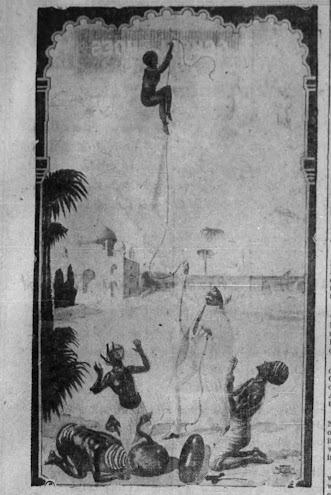
To illustrate this point, the reader is invited to step right up and consider the Indian Rope Trick. It goes something like this: the street performer throws a rope into the air, which becomes rigid as though hanging from an unseen platform. The rope is then able to be climbed, and various avenues of performance have been described following this initial feat of the impossible.* It's classic stage magic performance, more often written of or spoken of than actually seen, it has been explained away in the past as a form of mass hallucination. The fakir, adept in clouding the minds of men, simply convinces the audience that he is performing the familiar trick, and the audience fills in the blanks as they watch the show with slackened jaws. This sounds absurd, and an early reference to such a claim came from a cousin of Theodore Roosevelt.  In a Baltimore Sun article from 1927, Andre Roosevelt claimed to have filmed the trick being performed. He and the audience alike saw the performance as advertised, but yet the camera showed no such thing! “Hypnotism!” concludes the reporter, “That is the rope trick of India.” 


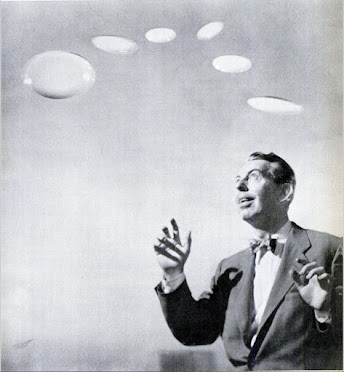
The explanations of mass hallucination and hypnotism have long been a part of the UFO narrative of skeptical explanations. Often, those who make these claims are stage magicians themselves. In 1952 John Mulholland, a popular stage magician who also worked with the CIA, described flying saucers as a “state of mind”. He goes on to say that his decades of stage performance experience taught him that all manner of intelligent people “can, by suggestion, quite readily be made to see things which aren’t.” In the same decade, FATE Magazine ran an article about the rope trick; another well-known magician, Joseph Dunninger, said he knew of 37 ways that the trick could be accomplished- most of which, he said, were impossible. Included among the unlikely methods of pulling of the feat was hypnotizing the audience into believing they had seen it. The control conditions would need to be very specific for such a thing to work, and it was much less risky to use one of the others. It seems an old explanation for the magic trick, when applied to odd things in the sky, is adequate- and yet unlikely for the trick itself. But the show must go on, and so it does. One wonders if the phenomena behind the saucer sightings might not be putting on a show of its own…


Mass hallucination seems like a convenient, albeit unlikely explanation in cases where no physical evidence is left behind. Without anything tangible, with only the testimony of witnesses, we are left to grapple with the very fallible aspects of human perception and memory. Even still, without a carefully directed hand to distract them from what the other is doing, the idea that a group of people would collectively hallucinate the same thing seems as unlikely as anomalous craft from other worlds landing near a school. It may actually make more sense that, as Mac Tonnes suggested, these beings intentionally reveal themselves as a performance of some kind. If all we have at the end is a good yarn with an unsatisfactory prosaic explanation, then we have to accept that and find new ways to contextualize it. But what of those cases in which the physical evidence is all you have, and the story of the origin along with its explanation is the part that’s missing? Enter: the Mystery Threads from Nowhere.


In August of 1970, according to Berthold Shwartz and later reported by John Keel, a silver thread inexplicably appeared over Caldwell, New Jersey. The thread, it appeared to Dr. Shwartz, “came from no place and went no place. It just hung there.” This phenomena was referred to as “Sky-Lines” in a 1971 issue of Pursuit Magazine, wherein the writers who investigated the case found at least half a dozen of such strands of what appeared to be fishing line dangled from an imperceivable source. In one instance, over the course of the several months these mysterious nylon strands grazed the ground in Caldwell, four local boys spent an hour hauling in the line before it finally snapped. Analysis of the strands by DuPont revealed that it was a nylon material of some sort, commonly used for fishing line, but the source remained a mystery. Perhaps even stranger, when Dr. Shwartz sent a sample of the material to another investigator, the envelope arrived intact with nothing inside of it. The strand had disappeared, presto change-o, as mysteriously as it had arrived. The mystery threads here seem to defy categorization; other than the fact that they seemed to come from the sky, there is no direct link to UFOs. In opposition to tales of sightings which leave no physical evidence, as concluded in the Pursuit article, “we have the thing, but the how and why of it remain totally mystifying.”


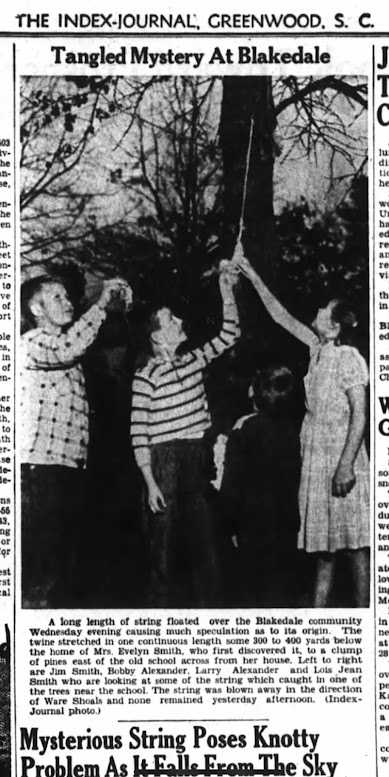
Mystifying though it may be, this was not the first case of Mystery Threads from Nowhere. In 1955 a small town called Blakedale, in South Carolina, was tangled up in its own anomalous twine. The string was described as being like the kind used to fly a kite, but not strong enough to hold a kite. A tangled ball of it was discovered on the roof of a Mrs. Smith, and the children took turns pulling on the drifting string until they tired of it and broke it off. The thread seemed to continue across town, leading to speculation that it had something to do with the military or perhaps came from a weather balloon, although neither explanation was borne out with any evidence. The only origin everyone could agree on was that it came out of the sky…


Another account was from a man named Hut Wallace, who discovered a glimmering strand above his house. Reported in a 1973 issue of FATE Magazine, the Georgia man called his friend who worked for the Atlanta-Journal Constitution to come and see it. Neither man could see any source for the dangling string, it just seemed to come down from a clear blue sky. Wallace’s nephew eventually got on the roof and hauled in yards of what appeared to be green fishing line, but never saw anything at the other end of it. A nearby company manufactured similar products, but how it could have gotten into the air, and what could possibly have dangled it, again beggars the imagination. 


The final example I will include here is the first one I came across, and had filed it in my memory as simply a good yarn as it was an anecdotal accounting of events and sounded utterly bonkers to me at the time. After all, who had ever heard of Mystery Threads dangling from the sky? The story was shared on Facebook by a man named Tim, and it occurred at Stonehenge in 1976. He was there for a music festival, when a kid handed him a string coming out of the blue sky. He figured there was a kite, but he couldn’t see anything at the end, so he started to reel it in. He could feel the pull as though there were a kite, but after 45 minutes of pulling in line he decided to pass the string off to some “likely looking candidate”. He admonished the man to not let go- “after all,” he said, with a wry wit that one often finds among the British, “we don't know what's on the other end... it might come crashing down, it might be depending on us, we might be depending on it... what if actually 'it' is flying us?” He concludes by wondering whatever happened with the string, and whether somewhere, someone is still holding the end of it. “I certainly hope so”, he said. 


There is something uncanny, mind-bending, and existentially disquieting about something so mundane as a nylon line defying all that we know of physics and by extension, reality itself. For such a common, unremarkable thing as a string to buck the norms of our expectations and leave itself behind for examination, only ever leaving in its wake more questions, one gets the sense that the yarns we take in, and the threads that we pull on, inform aspects of our shared experience of the world and all its weirdness far more than we care to let on. What if some being was “flying us”, holding on to the other end? What if, as suggested jokingly in an article about the New Jersey thread, something was fishing for us? What if the Mystery Threads are just intergalactic performance art, a way for the phenomena to show us an Indian rope trick of its own? After all, the rope trick is just that- a trick. Isn’t it?


I encourage anyone reading this to chase down these yarns, to pull on these threads, and remember to have fun with it. It’s all a show, and there’s no sense in coming apart at the seams…


-------------------------------

Addendum: a bonus "yarn" that's almost definitely not true, from The Saturday Blade, January 5th, 1895, in Chicago, Illinois.


*
An oversight on my part- initially I failed to actually describe the Indian Rope Trick. This has been corrected. The writer would like to express gratitude to his friend Theresa Meis, the Unicorn who breaths Fire, for pointing this out!